Limitation and forfeiture periods: the deadlines LexNET will never send you
Procedural deadlines arrive on their own, with a notification. Substantive ones only exist if the firm records them the day the client walks in. That is where most malpractice claims start.

A reasonably organised Spanish firm no longer misses procedural deadlines through carelessness. The notification comes in through LexNET, someone assigns it, the deadline is computed in court business days and lands in the calendar. There is an external trigger — the notification — and a routine that reacts to it. We cover that routine in detail in the LexNET notifications guide.
The deadlines that actually sink a firm are the others: the ones that run before any proceeding exists. Nobody notifies you that an action is about to become time-barred (prescripción) or that a right is about to lapse (caducidad). There is no court, no case number, no inbox. The clock starts on the day of the event, or the day the client learned of it, and the only record that it is running is the one the firm makes when the client first walks through the door.
Our view is simple: the substantive deadline must be computed and recorded at the first meeting, before the engagement is even accepted. Leave it for “once we have the documents” and the firm has taken on a risk it does not control. That — far more than procedural deadlines — is where a large share of professional liability claims originate: the action that was alive when the client came in and dead by the time the claim was filed.
The periods worth knowing by heart
Not a catalogue — just the ones that come up most in a general practice. All checked against the consolidated text in the BOE.
Limitation (prescripción — can be interrupted):
- Personal actions with no special period: five years from when performance could be demanded (art. 1964.2 of the Civil Code, as worded by Ley 42/2015, which shortened the general period).
- Non-contractual (tort) liability: one year “from when the injured party learned of it” (art. 1968.2 CC, read with art. 1902). This is the one that most surprises clients, who usually arrive convinced they have “years”.
- Employment-contract actions with no special period: one year from the end of the contract (art. 59.1 of the Workers’ Statute, ET).
Forfeiture (caducidad — not interrupted by making a claim):
- Unfair dismissal: twenty business days from the dismissal (art. 59.3 ET), which states that the period is one of caducidad “for all purposes”.
- Judicial review of administrative action: two months from the day after notification of the express act ending the administrative route (art. 46.1 of the Administrative Jurisdiction Act, LJCA).
- Challenging company resolutions: one year from adoption at the general meeting, or from when registration becomes effective against third parties if registered (art. 205 of the Companies Act, LSC) — except resolutions contrary to public policy, which never lapse.
- Hidden-defects warranty in a sale: six months from delivery (art. 1490 CC).
Unless a special rule says otherwise, time runs from the day the action could have been brought (art. 1969 CC). And the counting rule is in art. 5 CC: periods expressed in months or years run date to date, and in civil computation non-business days are not excluded.
Why the distinction is not academic
The practical difference comes down to one thing, and it decides what the firm does in the first week.
Limitation is interrupted “by bringing the action before the courts, by an out-of-court claim by the creditor and by any acknowledgement of the debt by the debtor” (art. 1973 CC). Once interrupted, the period starts again from zero. A well-drafted burofax — Spain’s certified-content letter with proof of delivery — buys time.
Forfeiture does not. A burofax sent on day 18 of a dismissal does not move day 20. The only exceptions are those the law spells out: the conciliation filing in dismissal cases (art. 59.3 ET itself), or, since Organic Law 1/2025, a request to open pre-litigation negotiation that properly defines its subject matter, which under its art. 7 interrupts limitation or suspends forfeiture until the negotiation ends — with its own restart rules if the other side does not reply within thirty calendar days.
The operational consequence: facing a limitation period, the firm has a cheap tool to gain room. Facing a forfeiture period, it only has the calendar.
August does not exist for these periods (almost)
This is where good-faith mistakes happen. Art. 183 of the Judiciary Act (LOPJ) makes August non-working for court proceedings, which we covered in the piece on August and procedural deadlines. But civil limitation and forfeiture are not court proceedings: they are substantive periods running on the ordinary calendar. Art. 5.2 CC does not exclude non-business days, so August, Saturdays and public holidays all count.
Two nuances worth knowing:
- Dismissal. The twenty days are business days, so Saturdays, Sundays and holidays are excluded. But August is a working month for this type of claim: art. 43.4 of the Labour Jurisdiction Act (LRJS) carves dismissal out of the August shutdown. A dismissal notified on 31 July does not wait until September.
- Administrative judicial review. The exception in the other direction: art. 128.2 LJCA provides that the time limit for filing does not run in August. Applying the civil rule here undercounts — a cautious mistake, but a mistake.
What you cannot do is apply a single rule to everything. That is why the type of period, not just its length, has to be recorded.
A worked example
On Monday 20 October 2025, a leak from the flat above — where the neighbour had building work under way — floods our client’s shop. She sees it that same morning. Stock is ruined and the shop closes for five days.
She does not come to the firm until Thursday 2 July 2026. She has been negotiating with the neighbour’s insurer and the conversation has gone cold.
First calculation, in the meeting. Tort liability: one year from when she learned of it (art. 1968.2 CC). Date to date, the period expires on Tuesday 20 October 2026. She has a little over three and a half months, with August in the middle — and here August counts in full.
That date goes into the case file that same Thursday, with its nature (“limitation, interruptible”) and its source (“art. 1968.2 CC; knowledge on 20/10/2025”). Not on a sticky note, not in the head of the lawyer who ran the first interview.
Interruption. The firm does not want to sue yet: it needs the surveyor’s report and would rather exhaust the negotiation. It sends a burofax with certified content and proof of delivery on Thursday 9 July 2026, expressly claiming compensation with a provisional figure. It is delivered on Friday 10 July.
From delivery, the one-year period runs again in full: new expiry on 10 July 2027, a Saturday. Because civil computation does not exclude non-business days, the firm does not count on the following Monday: it records Friday 9 July 2027 as its internal deadline, with a reminder three months earlier to decide whether to sue or interrupt again.
What Organic Law 1/2025 changes. If the burofax is also drafted as a request to negotiate with a well-defined subject, the art. 7 regime applies, with its own restart rules if the neighbour or the insurer does not reply within thirty calendar days. The sensible approach is to compute both dates, record the earlier one, and write down why.
What would have happened without that record. Had 20 October 2026 not been entered on 2 July, the file would have spent the summer waiting for the surveyor’s report with a sense that “nothing was urgent” — there was no proceeding and no pending notification. That is exactly how an action is lost.
What must come out of the first meeting
The engagement needs to reflect the matter, and the engagement letter is a good place to record that the client was told about the deadlines. But control does not live in the signed document; it lives in the calendar. When each matter is opened, the file should hold, at minimum:
- The possible action or actions, even provisionally.
- The period for each, its nature (limitation or forfeiture) and its legal source.
- The start date and why: date of the event, of knowledge, of delivery, of notification of the act.
- The computed expiry date and an earlier internal deadline, with a named person responsible.
- Every interrupting act, with its proven delivery date and the new expiry it produces.
None of this takes more than ten minutes. What it does take is making it a mandatory step when a file is opened, rather than a good habit of some lawyers. The case management guide covers how to fit that step into the intake of every matter.
Where Mandato fits
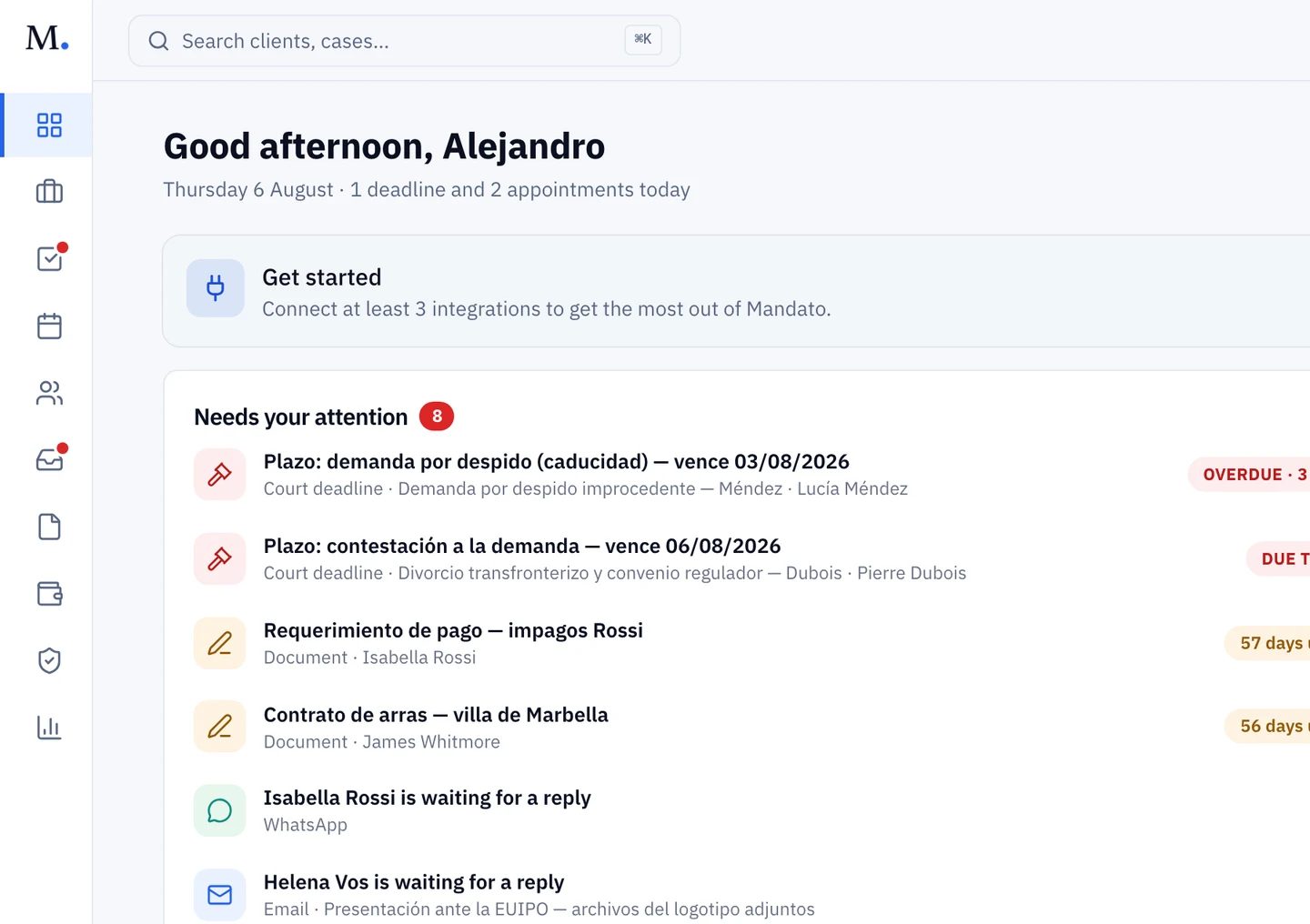
Mandato receives and organises LexNET notifications — which, as we have seen, is precisely the part that does not cover these periods. What it does allow is recording the substantive deadline as one more due date on the matter: when the case file is opened, the limitation or forfeiture date is entered with its type and source, and it sits in the firm calendar with an owner and reminders, alongside whatever procedural deadlines arrive later.
The legal judgement stays with the lawyer: which action, which start date, whether the burofax interrupts or not. What goes away is the reliance on someone remembering a date no external system will ever remind them of.
The consolidated Civil Code on the BOE is the reference for the articles cited.
Less admin. More law.
Mandato brings matters, communications, billing and compliance into one platform built for firms in Spain.