The engagement letter: what it must contain and why going without one no longer makes sense
Spain's Right of Defence Act, the General Statute of the Legal Profession and consumer law all push the same way. The minimum clauses, and a worked example of a properly scoped engagement.

Plenty of Spanish firms still work with a one-page hoja de encargo that says little more than “the client instructs counsel to defend their interests in the referenced matter” plus a figure. Others, especially with long-standing clients, sign nothing at all. For years that was tolerated bad practice. Today it is a named risk, and it comes from three different sets of rules pointing the same way.
What the rules say, without decoration
Organic Law 5/2024 on the Right of Defence. In force since 4 December 2024. Article 15.1 gives everyone the right to request that the engagement of defence services be put in writing in an engagement letter or equivalent, with understandable information about their rights, the essential steps, the main legal consequences of their decision and the prior estimate of fees and costs. Article 15.2 adds that the letter must include the Article 13 GDPR information where personal data are collected.
Article 6.2 completes the picture with the client’s right to be informed of, among other things, the viability of the claim and whether to use alternative dispute resolution, the general costs of proceedings and how fees are set, the consequences of a possible costs order, the possibility of applying for legal aid, and the lawyer’s identity, with Bar number and Bar.
General Statute of the Spanish Legal Profession (Royal Decree 135/2021). Article 27.1 requires the lawyer to give the client, before starting work, the information listed in article 48, “preferably by means of engagement letters.” Article 48.4 is more direct: the lawyer shall inform the client of fees and costs “by presenting the engagement letter or equivalent means,” and of the consequences of a costs order and its approximate amount.
Consumer law. When the client is an individual acting outside their trade or profession, they are a consumer under article 3 of the Spanish consumer protection code (TRLGDCU), and the firm is a trader under article 4. That brings the pre-contractual information duty of article 60 — including the total price or, if it cannot reasonably be calculated in advance, how it will be determined — and the unfair-terms regime of articles 80 and 82. The Court of Justice of the EU held in Šiba (C-537/13, 15 January 2015) that Directive 93/13 applies to legal services contracts with consumers, and in C-395/21 (12 January 2023) that an hourly-fee clause must let the consumer assess its economic consequences: the lawyer cannot know how many hours the work will take, but should give an estimate or commit to reporting accumulated hours at reasonable intervals.
So is it mandatory?
Formally, a written engagement letter remains a right the client can demand, not a condition of the contract’s validity. But the information it carries is mandatory either way, and it must be given before work starts. The practical question is not whether you can work without a signed letter, but how you will prove, on the day a fee dispute arises, that you complied with article 48 and article 60. A conversation in the office cannot be proved. A stray email with a number, only halfway.
Our view: with private clients, working without a signed engagement letter is no longer a matter of style. It means accepting that any fee dispute starts with you on the back foot.
The clauses that cannot be missing
1. Identification of the parties. The client, with the data due diligence already requires, and the firm: name, tax ID, Bar and Bar number, professional address and an electronic contact (article 48.1 of the Statute). For a professional company, its name, registry details and seat. If several lawyers will work on the matter, who leads it (48.2).
2. Object and scope, including what is excluded. This clause prevents more disputes than any other and is the one most poorly drafted. It must say which stages the price covers and, just as explicitly, what falls outside: appeals, enforcement, ancillary applications, related proceedings, registry work. “Defence in the matter” is not a scope.
3. Fees and how they are calculated. Fixed, by stage, hourly or mixed. If hourly, the rate, a reasoned estimate of hours and how often hours used will be reported, in line with the CJEU’s requirements. VAT stated.
4. Payment schedule and money on account. How much is paid on signing, at which milestones the rest falls due, and what happens if a payment on account is not made.
5. Expenses and disbursements. Procurador, experts, notary, registries, translations, travel. Say who engages and who pays each one. There is a tax reason to get this right: article 78.Three.3 of the VAT Act excludes from the taxable base amounts paid in the client’s name and on their behalf under an express mandate. The engagement letter is the natural place for that mandate.
6. Costs. What happens if the case is won (who gets costs recovered from the other side and how they are credited against fees) and what happens if it is lost, with an estimate of the amount. This is a literal requirement of article 48.4 of the Statute and article 6.2.e of LO 5/2024.
7. Duration and termination. The client can dispense with the lawyer at any time (article 5.1 of LO 5/2024), and the lawyer can withdraw. The letter should set the fees due if the engagement ends early, in proportion to the work done. A clause making a consumer pay the full fee whatever happens is the obvious candidate for an unfairness review.
8. Data protection. The Article 13 GDPR information, which LO 5/2024 requires in the letter itself and which can be given in layers under article 11 of the Spanish Data Protection Act. More in our article on GDPR for law firms.
9. Anti-money laundering. If the matter falls within article 2.1.ñ) of Law 10/2010 — sale of real estate or businesses, managing funds, setting up or running companies, among others — formal identification under article 3 must come before the business relationship. The engagement letter is a good moment to collect the documents, as explained in our article on KYC for lawyers.
10. Legal aid and alternative dispute resolution. One line each, because both are on the list in article 6.2 of LO 5/2024.
An example of a well-scoped engagement
A private client claims €38,000 from her building’s insurer for water damage. The firm presents this letter:
- Scope. Review of the matter; extrajudicial demand and the prior settlement attempt that Organic Law 1/2025 generally requires in civil matters; ordinary-proceedings claim and representation at first instance through to judgment.
- Excluded. Appeal or opposition to an appeal, enforcement, any other proceedings. If needed, a new engagement letter with a prior estimate.
- Fees. €4,500 plus VAT (€5,445 in total), in three instalments: €1,500 on signing, €2,000 when the claim is filed and €1,000 after the preliminary hearing.
- Early termination. If the engagement ends before the claim is filed, €1,500 is due; between filing and the preliminary hearing, €3,500.
- Expenses and disbursements. Procurador according to the official tariff, advanced by the firm and recharged as a disbursement under express mandate. Expert report estimated at €1,200–1,800, engaged and paid directly by the client.
- Costs. If she wins with costs, whatever the insurer pays towards lawyer’s fees is credited against outstanding instalments or refunded to her. If she loses and costs are awarded against her, article 394.3 of the Civil Procedure Act caps the part relating to lawyers and other professionals not subject to tariff at one third of the amount in dispute — €12,666.67 at most against a single opposing party, unless the court finds the losing party acted recklessly. Plus the other side’s procurador.
The client knows what she will pay if all goes well, what she will pay if she stops halfway, and what losing could cost her. That is exactly what article 48.4 of the Statute and article 6.2 of LO 5/2024 ask for, and what article 60 of the consumer code calls relevant information on the economic terms.
Signing, delivery and filing
An engagement letter between firm and client does not need a qualified signature; an advanced signature with good traceability is enough, as covered in our article on electronic signatures. What matters is that it is filed with the matter, dated, and that the client has an accessible copy. If the firm runs a client portal, that is the logical place: the client checks what the engagement covers instead of phoning.
And when the matter grows — an appeal arrives, enforcement appears — a new letter. Extending the engagement verbally is exactly the gap these rules are trying to close.
Where Mandato fits
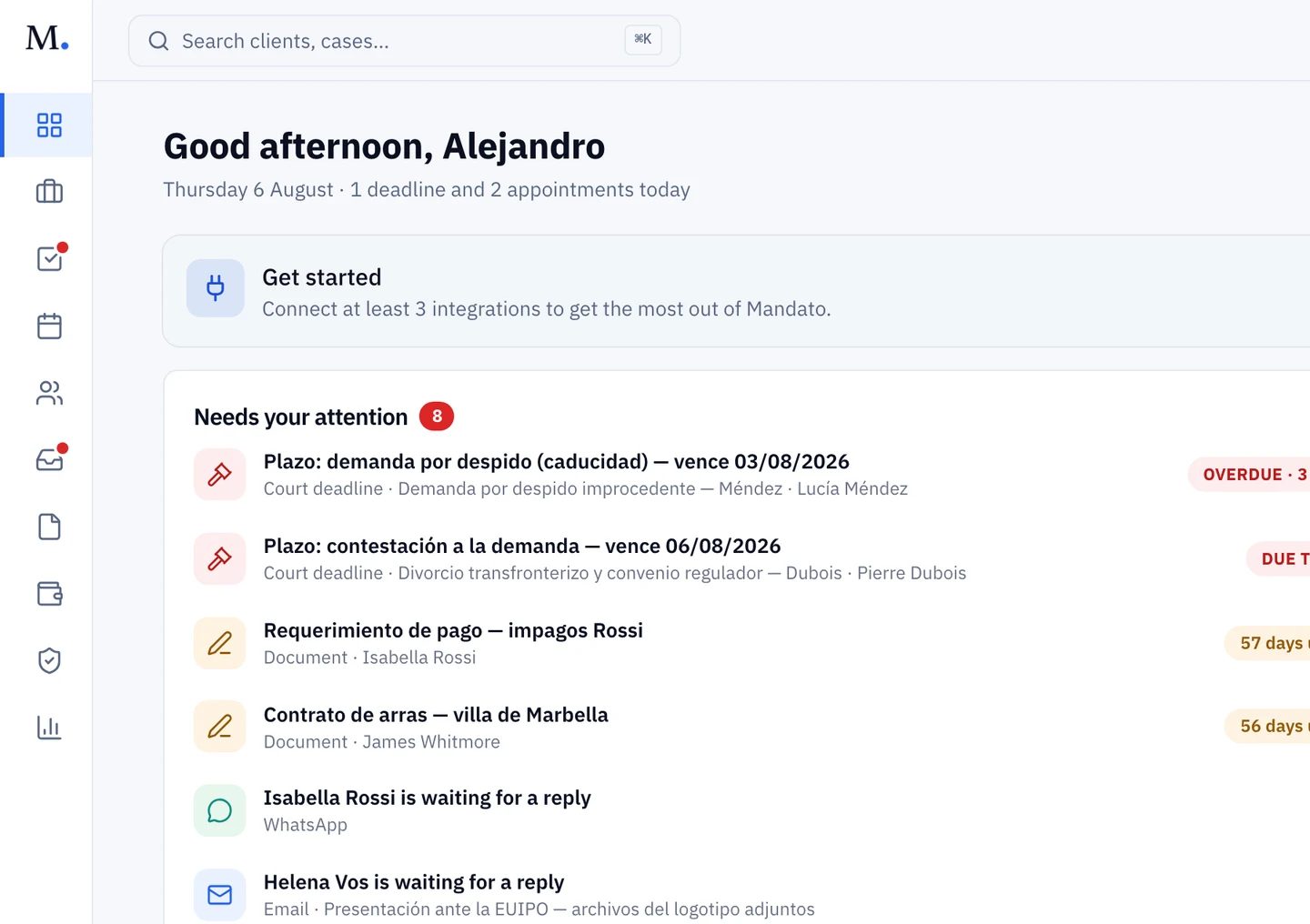
In Mandato the signed engagement letter is stored as a document in the case file, dated, alongside the rest of the matter, and the client can see it from their portal. Invoices are issued from the same case file, with the letter at hand to check what was agreed. What no tool does is scope the engagement for you: deciding what is in and what is out remains the lawyer’s job, and it is the part most worth doing well.
Less admin. More law.
Mandato brings matters, communications, billing and compliance into one platform built for firms in Spain.