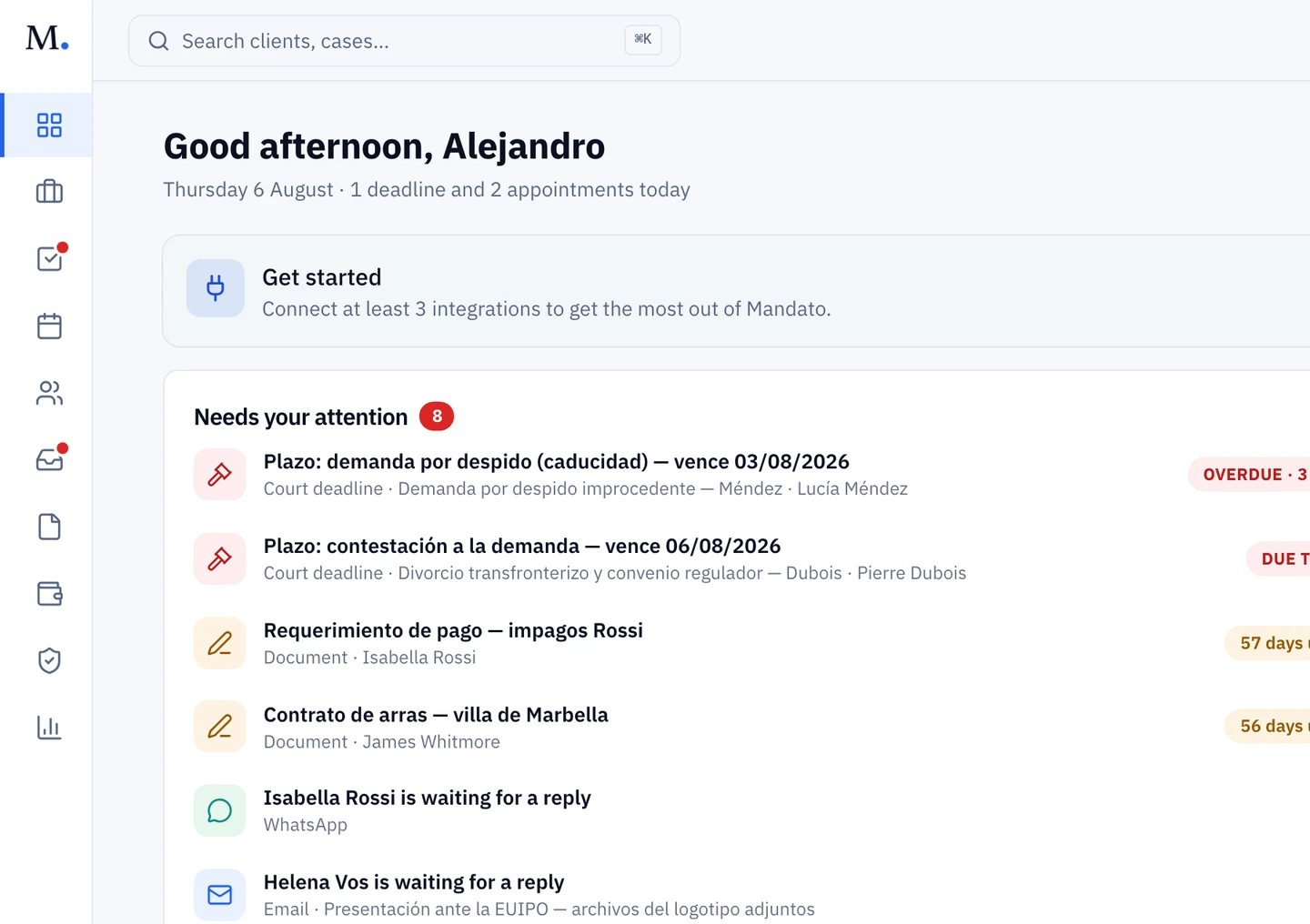
The deadline starts counting itself. You decide what to do with it
The notification arrives through LexNET, Mandato identifies the judicial act, applies the article that governs it and leaves the due date in the calendar counted in working days — with your court's local holidays and August already taken out. Without anyone typing a date.
Litigation is rarely lost for not knowing the law.
It is lost on a deadline. And a deadline is almost never missed through ignorance of it: it is missed because the notification arrived on a Thursday in July, the person who read it was covering for someone else, and the due date was written into a diary that was not the matter's. The error is not in the arithmetic. It is in the three manual steps between a resolution arriving and somebody writing it down somewhere.
Mandato removes those three steps. The LexNET notification is downloaded with its document, attached to the proceedings by its case number, and the judicial act it contains — a procedural order, a decree, a judgment — determines which deadlines it opens. Each one is computed from the notification date and appears in the calendar with the article it rests on in plain sight.
Mandato does the arithmetic; the procedural responsibility stays yours. The proposed deadline is always reviewable, deliberately so: the person who signs the pleading is the lawyer, not the software.
Real working days, with August and the holidays that apply to you
Counting twenty working days looks trivial until it has to be right. Out come Saturdays and Sundays, the national holidays, the regional ones, the local ones for the court's own seat and — in the civil jurisdiction — the whole of August, which is non-working under Article 183 LOPJ. Not in criminal: LECrim deadlines run in August exactly as they do in March, and that is precisely the detail that gets forgotten when the counting is done by hand.
Mandato's engine knows all four jurisdictions — LEC, LECrim, LRJS and LJCA — knows which one governs a given court from its orden jurisdiccional, and counts in working days, calendar days or months date-to-date according to what the applicable rule requires. An investigating court and a court of first instance are treated differently because they are different.
The rule set is a well-sourced starting point, not an exhaustive digest. Every deadline carries its article beside it precisely so it can be checked in a second against the resolution that opened it.
The appeals each resolution opens, already identified
A judgment opens twenty days to appeal under Article 458 LEC. A providencia or a non-final auto opens five for a reposición under 451. A decree of the letrado de la Administración de Justicia opens five for revisión under 454 bis. A payment order in a monitorio opens twenty to pay or oppose under 815.
None of that is hard to know. What costs time is doing it forty times a month without picking the wrong article, and what costs a case is doing it right thirty-nine times. Mandato proposes it as the notification lands; the lawyer confirms, adjusts or discards.
Hearings live in the same calendar as deadlines. A hearing and a filing due date compete for the same working week, and looking at them in two different calendars is how a week gets planned badly.
The whole matter, not a folder with the same name on it
Everything the proceedings generate hangs off the case number: the pleadings filed, the resolutions received, the hearing notes, the hours booked, the costs and disbursements, and the correspondence with the client and the procurador.
For a junior that means getting up to speed on someone else's matter is reading one screen instead of reconstructing it by asking around. For someone carrying twenty sets of proceedings it means the status of each one can be answered without opening four places.
Mandato's deadline calculation is advisory and is presented that way inside the product: it proposes the date, cites the article it comes from, and leaves confirmation to the responsible lawyer. The rule set covers the LEC, the LECrim, the LRJS and the LJCA with their references, but it does not exhaust every procedural situation, and no tool replaces reading the resolution. Electronic filing works through LexNET with your own colegiado credentials; Avantius and eJusticia.cat are not available yet. And CENDOJ case-law search needs a contracted gateway: without one, the legal research module runs on a demonstration corpus rather than the CGPJ's repository.
Frequently asked questions
Where does Mandato get the notification date from?
From the LexNET notification itself. On download, Mandato records the date it was made available and the date it was accessed, attaches the document to the proceedings by case number, and counts from there. If you would rather enter the date by hand — because the resolution arrived some other way — you can: the arithmetic is the same, what changes is who types it.
Does it take August out?
In the civil jurisdiction, yes: August is non-working under Article 183 LOPJ and the engine excludes it. In criminal it does not, because LECrim deadlines run through August too. That distinction lives in the rules, not in a checkbox somebody has to remember to tick.
What about local holidays?
National, regional and the court seat's local holidays all apply, configured by the firm. A hearing in Seville and one in Bilbao do not count the same, and counting both against the national calendar is the kind of mistake you only discover late.
Can I rely on the deadline it proposes?
You can use it for what it is: a proposal with its article beside it, computed the same way every time and not dependent on who happened to be covering that week. Confirmation belongs to the responsible lawyer, and the product says so in the alert itself. We would rather ship a tool that saves you the arithmetic and leaves you the decision than one that pretends not to need you.
Does it work for a small litigation practice?
That is where it shows most. A large firm has someone dedicated to tracking hearings and due dates; in a two- or three-lawyer firm that someone is the lawyer, between one hearing and the next. The Professional plan covers a litigation practice's daily work and includes read-only LexNET tracking; the LexNET and wider administration automation is on the Despacho plan.
Let the next deadline count itself.
Fourteen days with your own proceedings. No card, no lock-in, and nothing to migrate just to try it.