In family law, the matter that shouldn't be opened isn't opened
Confidential matters only the case team can see, procedural deadlines counted in working days, and a client who checks their own file instead of texting the lawyer's mobile at eleven at night.
Professional privilege is not a settings checkbox.
A family practice holds what nobody else holds: a contested custody arrangement, a psychosocial report, a division of assets that pits two members of the same club against each other, the divorce of a colleague's sister. The risk isn't an outsider getting into the system. It's someone inside opening a file they had no business opening.
Most legal software answers this with good intentions: everyone can see everything, and nobody is expected to look. That works until the day it doesn't — and that day isn't an IT incident, it's a conversation with a client you cannot have.
Mandato starts from the opposite premise. A matter can be marked confidential, and from that point only the lawyer running it, the firm's directors, and anyone expressly granted access can see it. This is not an interface filter: the restriction lives in the database, so the matter, its documents, its notes, its time entries and its communications all disappear for everyone else in the firm.
Confidentiality at matter level, not on trust
Directors hold the switch. Marking a matter confidential removes it from everyone else's lists, search results and reports; its documents stop downloading; its case notes and time entries stop being readable. Anyone who needs in is granted named access, and that grant is logged.
The rule is enforced by the database itself and reaches everything hanging off the matter — notes, documents, communications, time, expenses, hearings and filings — not just the header record. A colleague cannot open the matter even with the link.
Family procedure deadlines, in working days
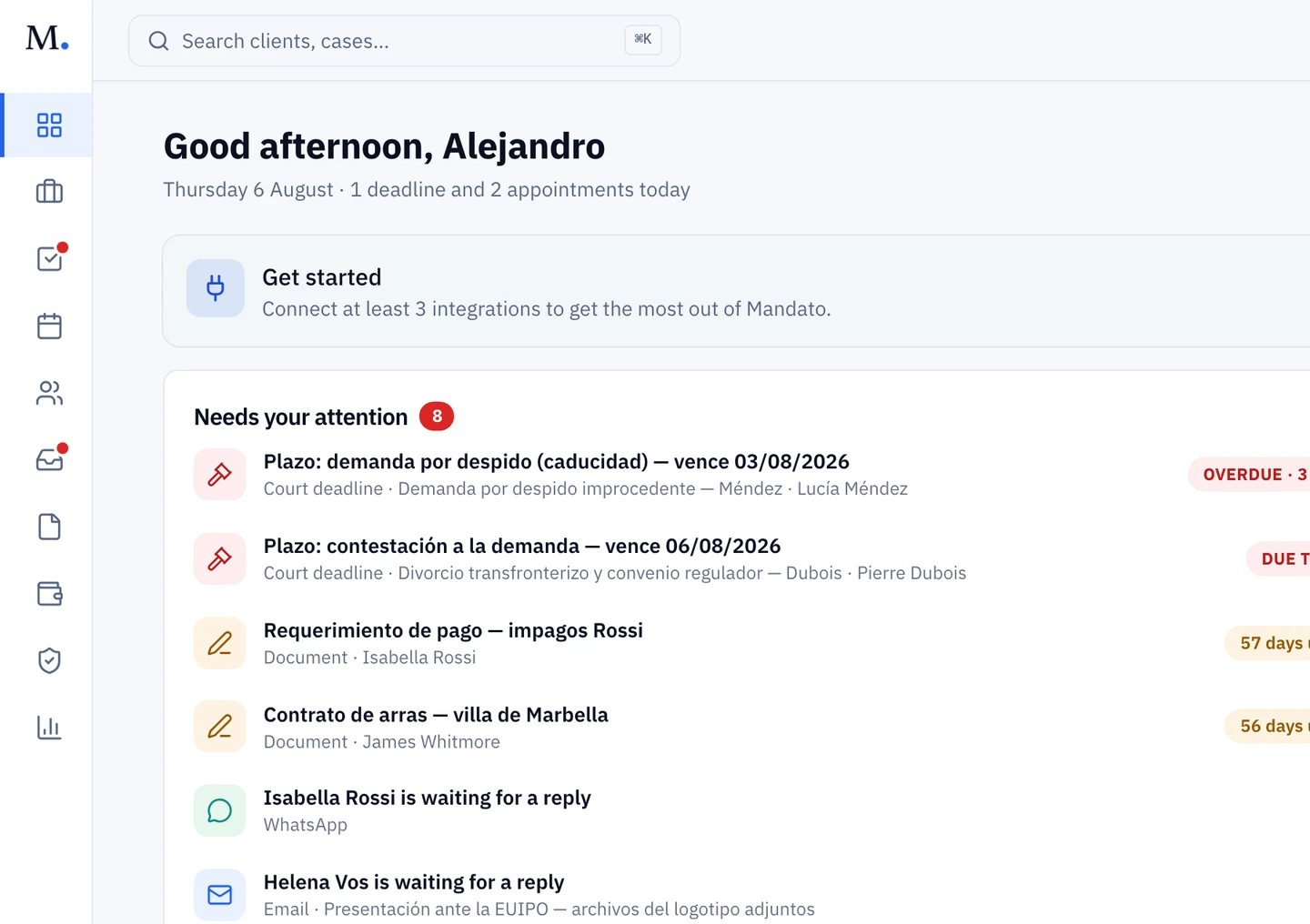
Defence to the petition, opposition to interim measures, appeal against the interim measures order: the clock runs from service, in working days, with August and the applicable holiday calendar taken out. Mandato does that arithmetic and marks each deadline green, amber or red by what's left, citing the article it rests on.
Hearings, listings and the dates in the settlement agreement live in the same calendar as the rest of the firm, with staged reminders before the deadline bites.
A client channel that isn't your personal mobile
Family clients write often, and they write at hard moments. The portal gives them somewhere to see where their matter stands, which documents are outstanding and what happens next — without every question arriving as a WhatsApp at eleven at night.
Every message and email stays on the matter, with who sent it and when. When someone else picks the matter up over a holiday or sick leave, the thread is where it should be and not on anybody's phone.
The procedure's templates, already in the firm
An uncontested divorce generates the same documents every time, and redrafting them from scratch on each file is not legal judgement: it is typing. Mandato ships a pack of family-procedure templates — the convenio regulador among them — with merge fields filled from the client and matter records: parties, children, addresses, dates and amounts.
What the template brings is the structure and the data. The content — the custody arrangement, the division of assets, the maintenance and how it is indexed — is written by the lawyer, because that is where the work is and where the responsibility sits. None of it is drafted for you by an AI, and that is a limit we are not moving.
Mediation matters are run like any other file, with their sessions in the calendar and their documentation in the same place, and with the same matter-level confidentiality where it is needed.
Mandato does not draft your settlement agreement or calculate maintenance: it does not replace the lawyer's judgement. Confidentiality protects a matter from other users of the firm, not from the directors, who keep access because they carry responsibility for the file. We also don't cover the regional justice systems — Avantius and eJusticia.cat are still outstanding — and the LexNET integration requires your own bar-issued access.
Frequently asked questions
Who can see a matter marked confidential?
The assigned lawyer, the firm's directors, and anyone expressly granted access. For everyone else the matter doesn't appear in lists or searches, and its documents, notes, time entries and communications are not reachable either. The restriction is applied in the database, not just on screen.
Can the client themselves see that their matter is confidential?
The client sees their matter as normal in the portal: confidentiality limits access by other members of the firm, never by the person whose matter it is.
Does Mandato calculate family procedure deadlines?
It calculates the due date in working days from service, taking out August and the applicable holidays, and cites the article it relies on. The calculation remains the lawyer's responsibility: Mandato makes it visible and warns you — it doesn't sign for you.
Where is the data held?
On infrastructure hosted in the European Union, with integration keys encrypted at rest. The security page sets out the per-firm isolation model and the subprocessors.
The delicate matter, in front of exactly the right people.
Start free and bring across the file you don't currently trust to a system.