August in Spanish courts: what stops and what keeps running
August freezes civil procedural deadlines, but not criminal investigation, much of employment litigation, administrative appeals or limitation periods. A jurisdiction-by-jurisdiction review and a real 2026 calculation.

Every Spanish firm hears the same line at the end of July: “nothing runs in August.” It is true for part of the work and false for the rest, and the false part gives no warning. A civil appeal deadline freezes; a dismissal claim, an administrative appeal or a claim about to become time-barred carry on as if it were March.
This piece goes jurisdiction by jurisdiction and ends with a real 2026 calculation. If what you need is how a LexNET notification is received and acknowledged, that is in the LexNET notifications guide; here we deal with the clock.
The general rule and what it actually says
Article 183 of the LOPJ (the Judiciary Act) makes the days of August non-business days — and, since Organic Law 14/2022, also 24 December to 6 January — “for all judicial proceedings, except those declared urgent by procedural law.” The Civil Procedure Act (LEC) repeats this in article 130.2, and article 133.2 supplies the mechanics: deadlines set in days exclude non-business days.
Two points to keep in mind from the start:
- What is non-business is the court activity, not the calendar. The rule is written for proceedings. Outside them — administrative procedure, substantive civil time limits — August is a month like any other.
- Urgent matters stay alive. Article 131 LEC treats as urgent anything whose delay could cause serious harm to the parties or the administration of justice, or render a decision ineffective, and for those August counts without any express order. Under article 133.2, only weekends and public holidays are then excluded.
Criminal: the investigation does not take holidays
Article 184.1 LOPJ and article 201 of the Criminal Procedure Act (LECrim) say the same thing in similar words: every day and hour of the year is available for the investigation of criminal cases, with no special authorisation. An order made in a criminal investigation on 10 August opens a deadline on the 11th, and an appeal against it will not wait for September.
The risk sits in the generalist firm, where whoever covers August applies the civil calendar out of habit. What the law makes available is the investigation stage; for later stages, check the regime matter by matter.
Administrative litigation: August stops, except for fundamental rights
Article 128.2 of the Administrative Jurisdiction Act (LJCA) is plain: in August neither the deadline to bring a judicial review claim nor any other deadline under the Act runs, except in the special procedure for the protection of fundamental rights, where August counts. Paragraph 3 also allows a party to ask for non-business days to be enabled in that procedure and for interim measures, and requires the court to grant it where refusal could cause irreversible harm.
The two months of article 46.1 LJCA therefore pause in August. The administrative stage that precedes them does not. More on that below.
Employment: the long list in article 43.4 LRJS
In the employment courts August is also non-business, but article 43.4 of the Employment Jurisdiction Act (LRJS) carves out a broad list of procedures, “both in the main proceedings and on appeal or enforcement”:
- dismissal, and termination under articles 50, 51 and 52 of the Workers’ Statute;
- geographical mobility and substantial changes to working conditions;
- suspension of contracts and reduced hours for economic, technical, organisational or production reasons or force majeure;
- work-life balance rights under article 139;
- challenges to medical discharges, and holiday disputes;
- union election matters, collective disputes and challenges to collective agreements;
- protection of fundamental rights and public freedoms.
Preparatory acts, precautionary and interim measures, and employment claims arising from Organic Law 1/2004 on gender violence are also excluded from the August pause.
The most serious practical consequence is in dismissals. Article 59.3 of the Workers’ Statute sets a 20-business-day time bar on challenging a dismissal, and since August is a business month for that procedure, the clock runs through it, excluding only weekends and public holidays. An employee dismissed on Friday 31 July 2026 who walks in on 1 September is too late: absent local holidays, the 20 business days ran out on Friday 28 August. Filing the mandatory conciliation request interrupts the period, per article 59.3 itself — but it has to be filed in August.
What August does not touch: administrative procedure
Law 39/2015 does not exclude August. Its article 30.2 removes only weekends and public holidays from deadlines in days, and deadlines in months run date to date under article 30.4. Internal administrative appeals (alzada and reposición) have one month (articles 122 and 124), and that month includes all of August.
An example using today’s date: an administrative decision notified on Monday 20 July 2026 must be challenged by recurso de reposición by Thursday 20 August 2026 at the latest. Whoever reasoned with the court calendar finds out in September. In the judicial review that follows, August stops counting again: the same matter changes regime when it walks through the courthouse door.
Nor limitation periods
Article 5.2 of the Civil Code says it in one line: civil time computation does not exclude non-business days. A tort claim under article 1968.2 CC is time-barred after one year; the action for hidden defects in a sale under article 1490 expires six months after delivery. Neither knows it is August.
For limitation (prescripción) there is a clean way out: article 1973 CC allows interruption by an extrajudicial claim from the creditor, and a burofax sent on 25 August works exactly like one sent in October. If your client’s one-year claim expires on Thursday 27 August 2026, you do not need to sue in August; you need a provable demand before that date.
For time bars (caducidad) there is no such exit, because they are not interrupted by a demand letter. Read article 135.1 LEC here: documents may be filed electronically every day of the year, but a filing made on a non-business day “shall be deemed made on the next business day and hour.” A claim lodged on 20 August to save a time bar expiring that same day is, procedurally, filed in September. It is not worth discovering in an interlocutory skirmish how your court resolves that. Our view is simple: a civil time bar that falls in August gets filed in July.
LexNET in August: what arrives and what waits
The last paragraph of article 162.2 LEC prohibits electronic service on professionals during August and from 24 December to 6 January, unless those days are business days for the step concerned. In practice:
- In August, LexNET should only bring you urgent matters, criminal investigation, fundamental-rights judicial review and the employment procedures listed in 43.4. If something arrives, read it carefully: if it came, it is probably running.
- Everything else accumulates and goes out in the first days of September. The first week of the month concentrates notifications of decisions handed down at the end of July, each starting its own deadline.
A real calculation: judgment served on 29 July
A first-instance judgment in ordinary civil proceedings. The procurador receives it through LexNET on Wednesday 29 July 2026. Deadline to lodge an appeal: twenty days (article 458.1 LEC).
- Date of service. Under article 151.2 LEC, service through the Procuradores’ Bar service is deemed made on the business day after receipt: Thursday 30 July.
- Day 1. The period starts the following day (article 133.1): Friday 31 July is day 1.
- August. Does not count.
- Days 2 to 20. Tuesday 1 to Friday 25 September, excluding weekends. There are no national holidays in that stretch (12 October, a Monday, falls outside it).
- Expiry. Friday 25 September 2026. The filing can still be made until 15:00 on Monday 28 September under article 135.5 LEC.
Three common mistakes on this same case:
- Forgetting 31 July. Whoever starts counting on 1 September gets Monday 28 as the last day and plans to file that afternoon. By then that Monday only exists until 15:00.
- Ignoring regional holidays. With 8 September (Asturias, Extremadura) or 11 September (Catalonia) in between, expiry moves to Monday 28 and the grace period to Tuesday 29 until 15:00. Local holidays come on top.
- Applying the procurador’s computation to the lawyer. If service goes directly to the lawyer, who opens it the same 29 July, the period starts on the 30th and expires on Thursday 24 September.
Getting August ready
In the last week of July, before anyone leaves, draw up three lists from the live files:
- Suspended procedural deadlines, with the new September expiry already calculated. September piles up deadlines; better to see them now.
- Deadlines that run in August: criminal investigation, the 43.4 employment procedures, administrative appeals, substantive limitation periods and time bars. Each with a named owner for the month.
- Expected notifications: pending decisions that will land in the first week of September.
Where Mandato fits
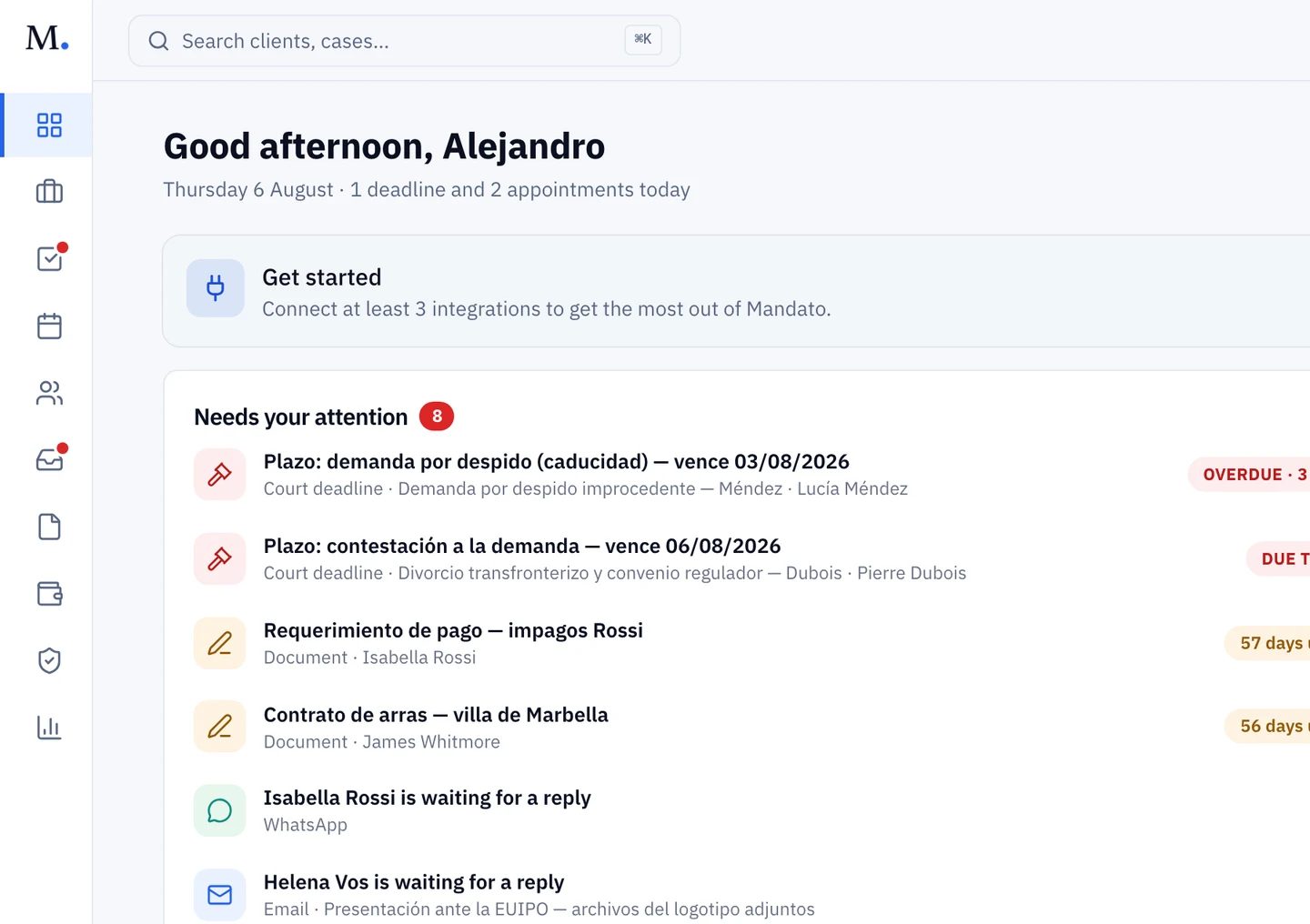
Mandato receives LexNET notifications inside the case file, calculates the deadline in business days using the calendar of the relevant court, and puts it on the firm’s calendar with an owner assigned. What no software does is decide whether your matter is one that runs in August: that call belongs to the lawyer, and it is best made in July. For the broader context of the system, the article on LexNET for lawyers is a good place to start.
Less admin. More law.
Mandato brings matters, communications, billing and compliance into one platform built for firms in Spain.