Changing lawyers in Spain: the venia, unpaid fees and handing over the file
The venia is no longer requested: it is notified, and it cannot be refused. What binds each lawyer when a client switches counsel, what happens to the outstanding invoice and how to hand over without losing a deadline that keeps running.

The email usually arrives on a Tuesday afternoon and opens with “Dear colleague”. A client has decided to change lawyers and the new one is letting you know. For the outgoing firm it is an awkward moment; for the incoming one, a dangerous one. Rarely because of the relationship between colleagues — but because in the middle of the handover there is a deadline running and neither of them has it diarised as their own.
The venia is no longer requested: it is notified
The word is still in use in Spain, but the institution has changed. The Spanish Bar’s Code of Conduct, approved by the General Council’s plenary on 6 March 2019, puts it in article 8.1: whoever takes over a matter another colleague was handling must notify them — “what is traditionally known as the venia, which may never be refused” — in a way that proves receipt or at least the attempt, stating that the client has instructed them. The notice goes out immediately after accepting the instruction and before taking any step.
The General Statute of the Spanish Bar, approved by Real Decreto 135/2021, sets out the same duty in article 60:
- The new lawyer notifies the previous one “in some form that records receipt”, evidencing the instruction.
- The outgoing lawyer, “as soon as possible”, acknowledges receipt, makes the matter’s documents in their possession available and provides the necessary information.
- The new lawyer is bound by professional secrecy over what is received, with particular care for communications between lawyers.
Article 60.4 refers, for electronic court files, to article 17 of Ley 18/2011. That law was repealed by Real Decreto-ley 6/2023, so the cross-reference is out of date, although the substance of the rule is unaffected.
Above both now sits Ley Orgánica 5/2024 of 11 November on the Right of Defence. Article 5.1 gives everyone the right to choose their lawyer freely and to dispense with their services; article 5.2 requires that, when counsel is replaced, whoever takes over has access to all the information they consider appropriate.
The operational upshot: the previous lawyer authorises nothing. They receive a notice and they have obligations.
What each side risks
The Bar Statute classes the following as serious infringements in article 125:
- Failing to notify the substitution to the outgoing colleague (art. 125.l).
- Unjustifiably encouraging the client not to pay the fees earned by the replaced colleague (art. 125.a.iv).
- Retaining client documents against the client’s express instructions (art. 125.a.v).
- Failing to send the documents to the lawyer taking over (art. 125.a.vi).
The Code adds that stepping in at a procedural act without prior, timely written notice to the outgoing lawyer is “especially serious” (art. 8.8). And where it is impossible to notify or to prove receipt, the notice can go to the Dean or the competent bar body, which acknowledges it, and the substitution is then complete (art. 8.9).
Unpaid fees do not hold up the handover
This is where practice goes wrong most often, so precision matters.
The previous lawyer is entitled to be paid for work done. The Code requires the new lawyer to tell the client about that right and the client’s duty to pay, “without prejudice to any disagreement” (art. 8.4). This is not a courtesy; it is part of the incoming lawyer’s duty.
But that right does not allow the file to be withheld. Article 12.A.10 of the Code is blunt: documents received from the client are always at the client’s disposal and cannot be retained “not even on the pretext of unpaid fees”. The lawyer may keep a copy. And there is a limit in the other direction: the client is never given copies of communications between the lawyers involved.
To get paid, the outgoing lawyer has their own routes, starting with the jura de cuentas fee claim where the fees arose in court proceedings. What they do not have is security over the client’s papers. The engagement letter signed at the outset is now their best protection: fees agreed in writing are argued over far less.
Our view: the outgoing firm that hands over quickly and completely, and pursues its invoice separately, gets paid sooner and with less friction than the one negotiating with the file on the table. Beyond being what the rules require, it is what works.
Worked example: an appeal in the middle of a handover
A Madrid firm is handling ordinary civil proceedings for a company. The court dismisses the claim.
- Monday 21 September 2026, 11:40. The court agent (procuradora) receives the judgment through the Procurators’ Bar notification service. Under article 151.2 LEC, service is deemed made on the next working day: Tuesday 22 September.
- The time limit to lodge an appeal is twenty days (art. 458.1 LEC), counted in working days (art. 130 LEC) from the following day (art. 133 LEC). It starts on Wednesday 23 September. Excluding weekends and Monday 12 October, a national holiday, it expires on Wednesday 21 October. With the grace day under article 135 LEC, the appeal can be filed until 15:00 on Thursday 22 October.
- Tuesday 29 September. The company, unhappy, signs an engagement letter with another lawyer. That afternoon she sends the substitution notice to the previous firm by email with a read-receipt request, attaching proof of instruction. Five working days of the appeal period have already run.
- Thursday 1 October. The outgoing firm acknowledges and mentions an outstanding invoice of €2,400 plus VAT. The incoming lawyer informs the company in writing of that entitlement, as article 8.4 of the Code requires.
- Friday 2 October. The outgoing firm delivers the documents with a handover note whose first line reads: “Judgment served; appeal deadline 21/10/2026; grace period until 15:00 on 22/10/2026”. Twelve working days remain.
Changing lawyers does not stop the clock: service on the court agent has already started it. Had the handover note not flagged the date, the incoming lawyer would have had to reconstruct it from the agent’s receipt. And had the company also changed court agent, the change would have had to be recorded in the proceedings for the new agent to receive notifications (article 30 LEC governs the agent’s cessation and the tacit revocation of the power of attorney when another one appears).
Handover protocol for the outgoing firm
On the day you acknowledge receipt, or as soon as possible:
- A written handover note. First, running deadlines with their expiry date and the document they stem from. Then upcoming hearings. Then everything else.
- Notifications not yet dealt with: anything received and not yet passed to the client or answered.
- A complete copy of the proceedings: filings, exhibits, decisions, filing receipts.
- The client’s originals, returned or made available, with a signed list.
- Useful context: court agent, opposing party and counsel, open negotiations, experts contacted.
- The invoice, separately. Not in the same email as the handover note.
If the outgoing lawyer is withdrawing rather than being dismissed, the Code requires written, verifiable notice to the client and whatever steps are needed to avoid leaving the client defenceless (art. 12.A.6). And where the person leaving is a lawyer quitting the firm and taking clients, the Statute classes taking or retaining client documents of the former firm without the client’s express authorisation as a very serious infringement (art. 124.l). That is a different scenario, but worth keeping in mind, along with the conflict-of-interest questions it can raise.
Checklist for the incoming firm
- Substitution notice before any step, with acknowledgement or proof of the attempt.
- Signed engagement letter before the notice: you need it to evidence the instruction.
- Live deadlines rebuilt from the notifications themselves, not only from your colleague’s note. If the note and the notification disagree, the notification wins.
- Appearance or notice to the court of the change of counsel. The Code says the incoming lawyer must notify it in every case (art. 8.7).
- Notifications: check who is receiving them. With a court agent, they go to the agent; without one, check which lawyer the court has on record so that LexNET notifications do not keep going to your predecessor.
- Tell the client, in writing, about the previous lawyer’s fees.
Where Mandato fits
Handovers fail on details: the date that was not in the note, the notification that went to the previous lawyer. We cover this in more depth in the case management guide.
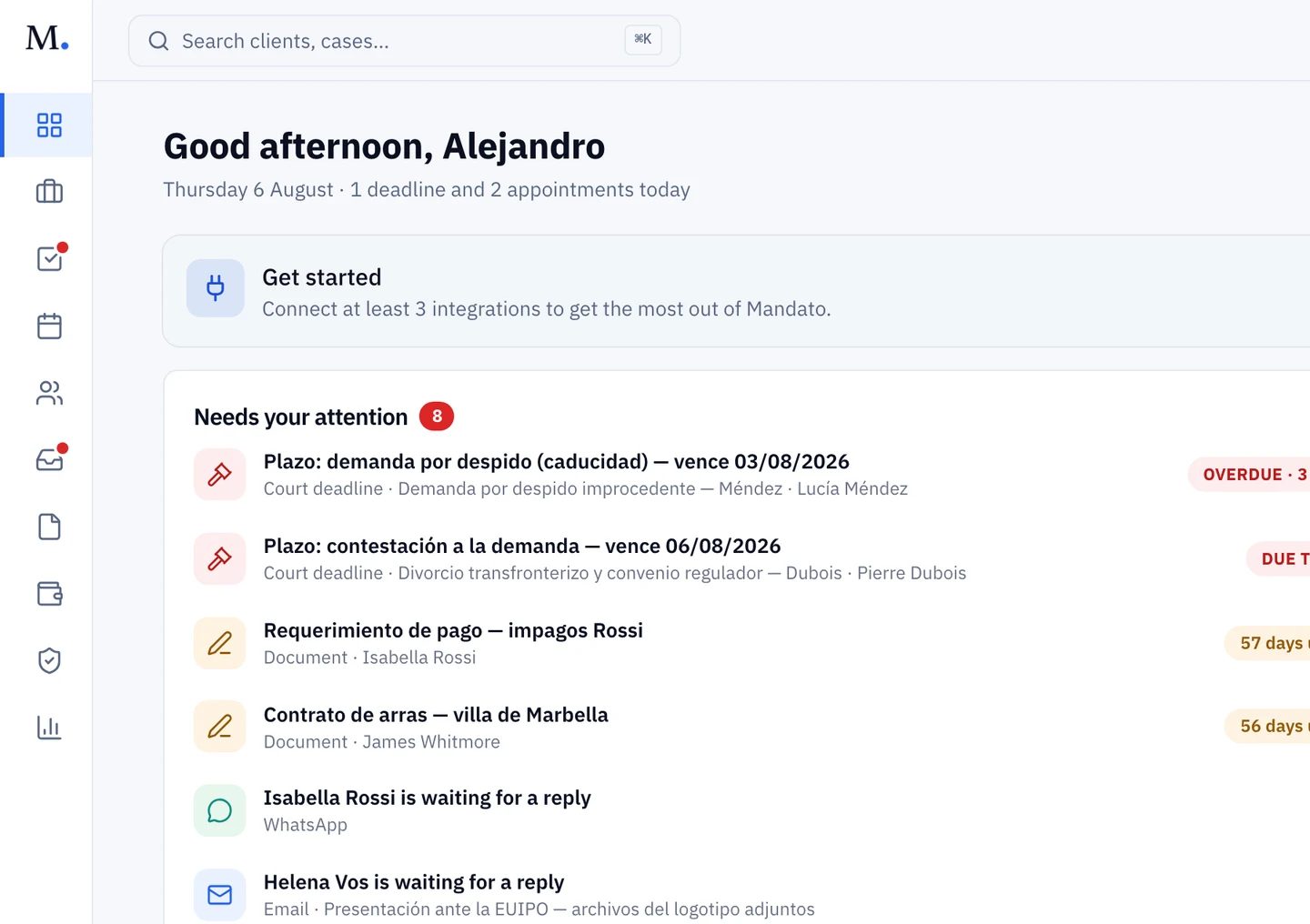
In Mandato the case file brings deadlines, received LexNET notifications and documents together, so the handover note can be drawn from what is already recorded, and the incoming firm can enter live deadlines from day one. The final check against the notifications remains the lawyer’s.
Less admin. More law.
Mandato brings matters, communications, billing and compliance into one platform built for firms in Spain.