Remote hearings in Spain: when you can appear from your office and what must be ready
Since March 2024, remote attendance is the preferred rule under the Civil Procedure Act, but oral evidence still calls for the courtroom. What the law says, where the exceptions are and the checklist before you connect.

Since 2024 an idea has been going round Spanish firms that is only half true: “everything can be done by video now”. The true half is that the law has reversed the default. The false half is that oral evidence — examining a party, a witness, an expert — still requires physical presence by default. And if the person testifying is your client, so does yours.
It is worth having the map clear before you answer the client who asks whether he really has to travel from Seville to Madrid.
The general rule: remote by preference
Real Decreto-ley 6/2023 of 19 December added article 129 bis to the Civil Procedure Act (LEC), in force since 20 March 2024. Paragraph 1 says that, once the court is sitting at its seat, trials, hearings, appearances and statements “shall preferably be held by remote attendance”, provided the court offices have the necessary technical means. It adds a condition that is not decorative: remote participation always goes through a secure access point (punto de acceso seguro).
In criminal matters, article 258 bis of the Criminal Procedure Act (LECrim) contains a parallel rule with its own regime for the accused: mandatory physical presence in trials for serious offences and before a jury, and physical presence in other cases where the accused or their lawyer asks for it or the court considers it necessary. This article focuses on civil litigation; anyone handling criminal cases should read that provision in full, because its exceptions are finer-grained.
The organic basis is article 229.3 of the Judiciary Act (LOPJ), which allows videoconferencing as long as adversarial debate and the right of defence are preserved.
The exceptions that matter: oral evidence
Paragraph 2 of article 129 bis is the one people forget. Where the act consists of hearing, taking the statement of or examining parties, witnesses or experts, examining a minor, a personal judicial inspection or interviewing a person with a disability, physical presence is required of the person concerned and, where that person is a party, of their lawyer as well.
There are three carve-outs:
- The judge, given the circumstances, orders otherwise.
- The person lives in a different municipality from the court’s seat. They may then, at their request, take part from a secure place (lugar seguro) in their own municipality.
- They take part as a public authority or official, from a secure access point.
In cases 2 and 3 the judge keeps the final say and may require physical presence by reasoned decision (art. 129 bis.3).
In practical terms: a preliminary hearing (audiencia previa), an interim-measures hearing without oral evidence or a procedural appearance are natural candidates for joining from the office. A trial where your client is cross-examined is not, unless the court allows it.
Secure access point and secure place are not the same thing
Article 62 of RDL 6/2023 defines both, and the difference has consequences.
A secure access point is a device or information system meeting the requirements set by the State Technical Committee for Electronic Judicial Administration: secure transmission, identification of participants, integrity and confidentiality of the proceedings. In practice it is the platform and access method the court enables. It is what a lawyer needs to connect from the office.
A secure place is a physical location. The law treats as such, in all cases, court and prosecution offices and municipal justice offices, civil registries within their remit, forensic medicine institutes, police premises for their own officers, the premises of public legal services, prisons and detention centres, plus any added by regulation. It must allow identity and the participant’s autonomy to be verified, guarantee a private conversation with their lawyer and offer means to digitise documents.
A law office is not on that list. So when the law calls for a secure place for your client to testify, your meeting room will not do, however good the connection.
What the connection requires
Article 60 of RDL 6/2023 sets rules for everyone taking part:
- Identification at the start of the act, organised by whoever presides. Professionals should preferably access with electronic identification, prior or simultaneous and specific to that hearing.
- No filters that alter image or sound, except to protect identities that must be kept confidential.
- The same rules of decorum, dress and respect as in the courtroom (art. 60.6). Since article 187 LOPJ requires lawyers to wear the gown in public hearings, the prudent reading is that the gown goes on for a remote hearing too. Keep one at the office.
If you want to appear by video where the court has not provided for it, article 137 bis LEC requires the request to be made sufficiently in advance and in any event ten days before the hearing. The same article places remote participation by default at the court office of the district where you live or work, and lets the judge authorise “any place” that secures identification. The two provisions sit in some tension; in practice, if the summons does not say the hearing is remote, ask in writing and assume nothing until you have a decision.
If any of these rules is breached, article 61 of the RDL clarifies that this does not, by itself, deprive the act of effect or render it void. That is not a safety net for counsel’s mistakes; it is there so that a hearing does not collapse over a formality.
Worked example: the preliminary hearing from Seville, the trial in Madrid
A Seville firm acts for a defendant company before the Madrid first-instance court (civil section) in an ordinary breach-of-contract claim. The company’s director lives in Seville.
Preliminary hearing, Thursday 29 October 2026, 10:00. No oral evidence: agreeing facts, proposing evidence, perhaps a procedural objection. This is squarely article 129 bis.1. If the summons does not mention remote attendance, the firm files a request no later than Monday 19 October — ten days before the hearing — although the sensible move is to ask the same week the summons arrives. If the court agrees, the lawyer appears from her office through the access point the court specifies.
Trial, with the claimant proposing to examine the director. Now article 129 bis.2 applies: physical presence of the director and of his lawyer in court. But the director lives in another municipality, so he can ask to testify from a secure place in Seville, such as a court office. The rule does not clearly say where his lawyer should then be; the request should raise it expressly. The claimant may object, and the judge can require physical presence by reasoned decision based on specific features of the case.
Our view: for hearings without oral evidence, always ask for remote attendance; you save a day’s travel and the quality of your advocacy does not change. For the examination of your own client in a case that may turn on it, go to court even if you could avoid it. Reading the judge’s face and sitting next to your client are still worth more than the train fare.
Checklist before you connect
Forty-eight hours before
- Confirm in the summons or decision that remote attendance has been granted, and save the link and access instructions to the case file.
- Test access with the same machine, network and identification method you will use on the day. An expired certificate is better discovered on Tuesday than at 9:55 on Thursday.
- Have the court office’s phone number to hand. If the connection fails, it is the only channel that works.
The document bundle
- Everything you may cite in a single local folder, numbered as in the court record: claim, defence, exhibits, relevant decisions.
- Your evidence proposal in writing, so you can read it without searching.
- If you need to show something new, ask the court beforehand how it wants to receive it. Do not improvise with screen sharing.
The room that is your office
- A closed room with nobody present who should not be. If your client is beside you, say so when participants identify themselves at the start.
- Neutral background, camera at eye level, headset with microphone. Gown on.
- Phone on silent and desktop notifications off.
If the connection drops
- Call the court office immediately and tell them; try to reconnect through the same link.
- If the outage prevents the hearing from continuing, it can be interrupted and resumed under article 193 LEC. Ask for the incident to be recorded.
- Afterwards, note in the case file when the connection dropped and when it came back, in case there is later argument about what was heard.
The recording
- The official recording is the court’s (art. 147 LEC), and parties may ask for a copy. Request it if you need it for an appeal rather than recording on your own.
How it fits into the firm’s day-to-day
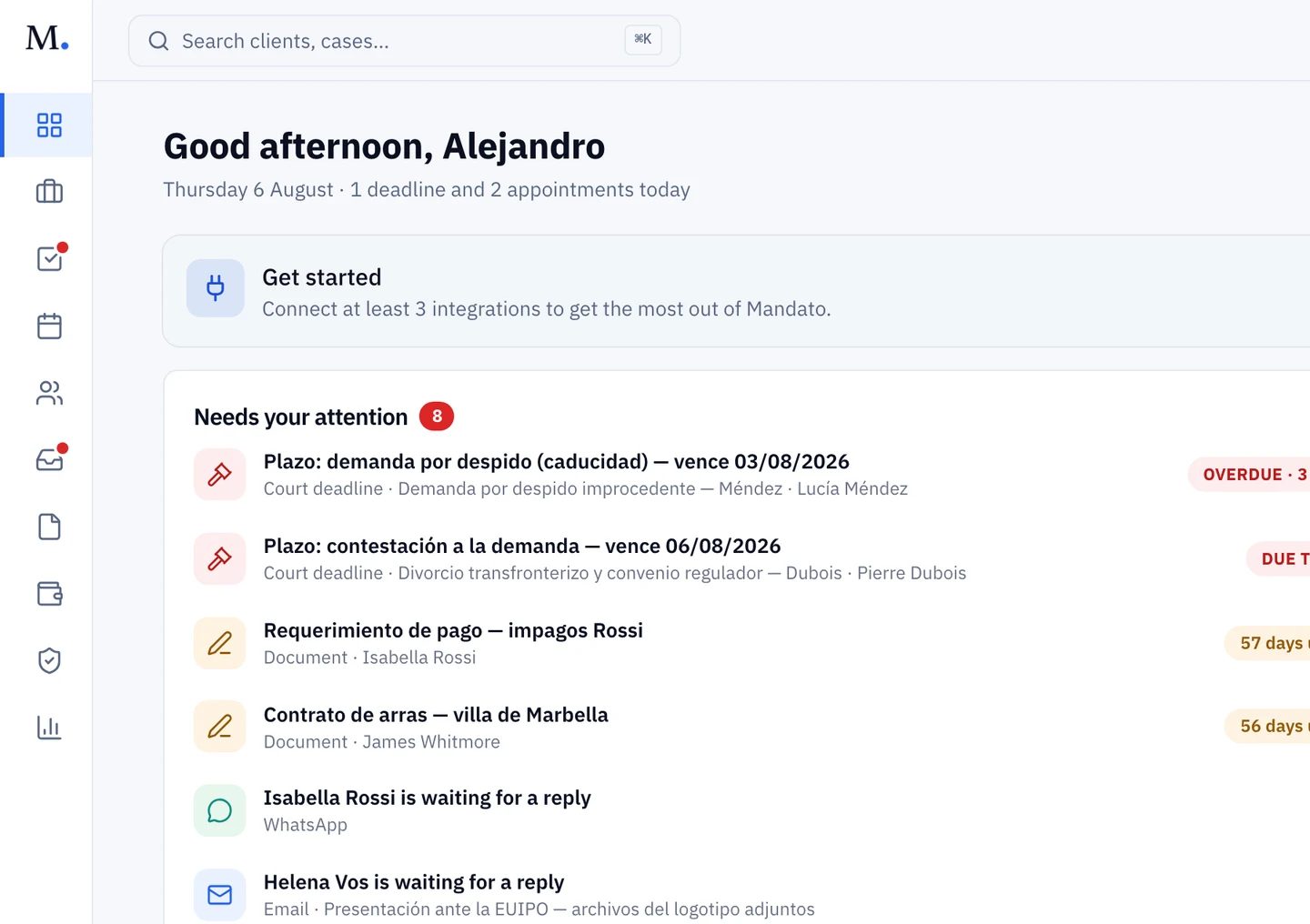
A remote hearing has more moving parts than an in-person one: the link, the connection test, the videoconference request with its own lead time, the document bundle. If those pieces live in each lawyer’s inbox, one of them gets lost. It is the same logic as in our piece on the move to first-instance courts: procedural changes show up first in the calendar.
In Mandato each hearing can carry its own preparatory tasks (request remote attendance, test the connection) with dates, and the link and document bundle sit in the case file rather than in an email. LexNET notifications carrying the summons are received and organised in the same matter. If your practice is mainly civil litigation, that is a sensible place to start.
Less admin. More law.
Mandato brings matters, communications, billing and compliance into one platform built for firms in Spain.