Tribunales de instancia: what changed for the litigating firm
Spain's single-judge courts no longer exist. What LO 1/2025 means in practice for how you identify the court, address filings and keep each case file's data current.

Since 31 December 2025 there is no longer a single “Juzgado de Primera Instancia nº 3” anywhere in Spain. What exists is a plaza, with the same number, inside a section of a court. For the judge, the change is mostly organisational. For the firm it is something else: a change of names across hundreds of case records, templates and filing headers that nobody reviews because “the case is still in the same place”.
It is still in the same place. What changed is what that place is called, and who receives what you file.
What LO 1/2025 actually did
Ley Orgánica 1/2025, of 2 January, on efficiency measures for the Public Justice Service (BOE, 3 January 2025), rewrote article 84 of the LOPJ: there is one Tribunal de Instancia in each partido judicial, seated in its capital and named after it. At minimum it has a single Civil and Investigating section (Sección Única de Civil y de Instrucción), or separate Civil and Investigating sections where the court map splits them. On top of that it may have sections for Family, Children and Legal Capacity; Commercial; Violence against Women; Violence against Children and Adolescents; Criminal; Juveniles; Prison Supervision; Administrative; and Labour.
The transformation happened in stages. The first transitional provision set three dates:
- 1 July 2025: districts that had only combined first-instance-and-investigating courts and violence-against-women courts. They became single Civil and Investigating sections. The Ministry of Justice counted 315 courts in this phase.
- 1 October 2025: districts with separate first-instance, investigating and violence-against-women courts and no other kind. There were 16.
- 31 December 2025: everything else, meaning provincial capitals and districts with criminal, labour or administrative courts. Around a hundred courts, plus the Tribunal Central de Instancia, which replaced the Juzgados Centrales.
The same provision contains the rule with the most day-to-day impact: each judge takes the plaza in the new section carrying the same cardinal number as their former court, and keeps the cases already under way. There is one exception. In Family, Children and Legal Capacity sections, numbering restarts at one, following the order of the original courts. In a city with several family courts, the old nº 5 may now be plaza nº 1 of its section.
The court office: who receives your filing
The second change is less visible and matters more. Amended article 436 LOPJ says the court office (oficina judicial) works through common services. Each Tribunal de Instancia is supported by a common processing service (servicio común de tramitación, art. 437) that manages the procedure. Administrations may also set up common services for registration and allocation, service of process, enforcement and more (art. 438).
In plain terms: the clerk handling your case no longer belongs to “your” court but to a service covering several plazas or sections. The phone call to “number 3’s” clerks becomes a call to an area or team inside the common service.
The roll-out of those offices was less punctual than the courts themselves. The fifth transitional provision allowed specific offices to be delayed for exceptional infrastructure or technology reasons, and the court clerks’ associations described an uneven deployment in the first weeks of 2026, with several regions finishing staff reassignment during the first quarter. Nine months on, the court data your firm recorded between November and March is the most likely to be wrong.
Justice-of-the-peace courts, renamed
On the date each Tribunal de Instancia was constituted, the Juzgados de Paz became Oficinas de Justicia en el municipio (sixth transitional provision). The justice of the peace still exists and works with the support of that office, which also takes on new services (arts. 439 ter to 439 quinquies LOPJ).
In LexNET, the change shows up in the mailbox name. The Ministry’s notice on the third phase gave two examples from the Ponferrada district: the Juzgado de Paz de Bembibre became “Oficina de Justicia de Bembibre”, and the Juzgado Decano (the dean’s office) became “Presidencia del Tribunal de Instancia de Ponferrada”. From that date the deans’ offices stopped receiving filings; initial filings go to the district’s common registration and allocation service. If your claim templates still open with “Al Juzgado Decano de…”, you know which line to change.
How a court is designated now: an example
The table below is illustrative. It applies the numbering rule in the first transitional provision but does not reproduce any district’s official equivalence table. Before changing a record, check the designation on the last notification received or in LexNET’s equivalence list.
| Before | Now (illustrative) |
|---|---|
| Juzgado de Primera Instancia nº 3 de [district] | Tribunal de Instancia de [district], Sección Civil, plaza nº 3 |
| Juzgado de Primera Instancia nº 5 de [capital] (family) | Tribunal de Instancia de [capital], Sección de Familia, Infancia y Capacidad, plaza nº 1 |
| Juzgado Decano de [district] | Presidencia del Tribunal de Instancia de [district]; filing via the registration and allocation service |
| Juzgado de Paz de [town] | Oficina de Justicia de [town] |
The second row is the one that causes mistakes. A lawyer who remembers “family court 5” and writes it that way is citing a plaza that may no longer carry that number in its section, or that does and belongs to a different judge.
A worked case: one week in February
A three-lawyer firm in Marbella closed 2025 with 112 live court cases: 61 civil matters in Marbella, 18 family matters in Málaga, 21 criminal matters split between investigating and trial courts, and 12 administrative cases in Málaga. Nobody updated the records. “Same judge,” said the partner.
On Monday 2 February 2026 a notification in one of the family matters is deemed served. It gives five working days to cure a defect. Under the counting rule in article 133 LEC the period runs from the next day: Tuesday 3, Wednesday 4, Thursday 5, Friday 6 and Monday 9. It expires on Monday 9 February, with the grace day under article 135 LEC running until 15:00 on Tuesday 10.
The associate drafts the filing on Monday 9 from the case template, which still says “Juzgado de Primera Instancia nº 5 de Málaga”, and looks for a court by that name in LexNET. It isn’t there. She spends the morning working out the equivalence and files on Tuesday at 13:40: in time, by eighty minutes. With an updated record it would have been a five-minute job on the Monday.
The fix is cheap. At roughly three minutes per case (open the last notification, copy the designation, update record and template), 112 cases come to 336 minutes, a little under six hours of one person’s time. That is less than that one February morning cost in stress and unbillable hours.
What to review at the firm
- Each case record. Court, section and plaza as separate fields, not one text string. If your system allows it, identify the matter by procedure number and NIG rather than by court name.
- Filing templates. Headers, “Al Juzgado Decano”, “Al Juzgado de Paz”. Few templates, many uses.
- Court directory. Addresses, clerks’ phone numbers and mailboxes. The “court” phone number now usually reaches an area of the common service.
- Calendar. Old hearings carry the old name. It is enough for the event to link to the case and for the case to hold the right data.
- Client communications. A client summoned by “Tribunal de Instancia, Sección Civil, plaza nº 3” will not recognise the “court number 3” you told them about. One line in your next message saves the phone call.
The opinion, plainly: the new court structure changes no deadline, but it multiplies the chances of losing hours to a badly stored data point. A litigating firm should have its court data reviewed by now. If it doesn’t, the best moment is before the first filing in October.
If you are also dealing with the other half of LO 1/2025, the ADR pre-filing requirement, we cover it in the piece on proving the attempt to negotiate. For the mechanics of deadlines after a notification, see the LexNET notifications guide.
Where Mandato fits
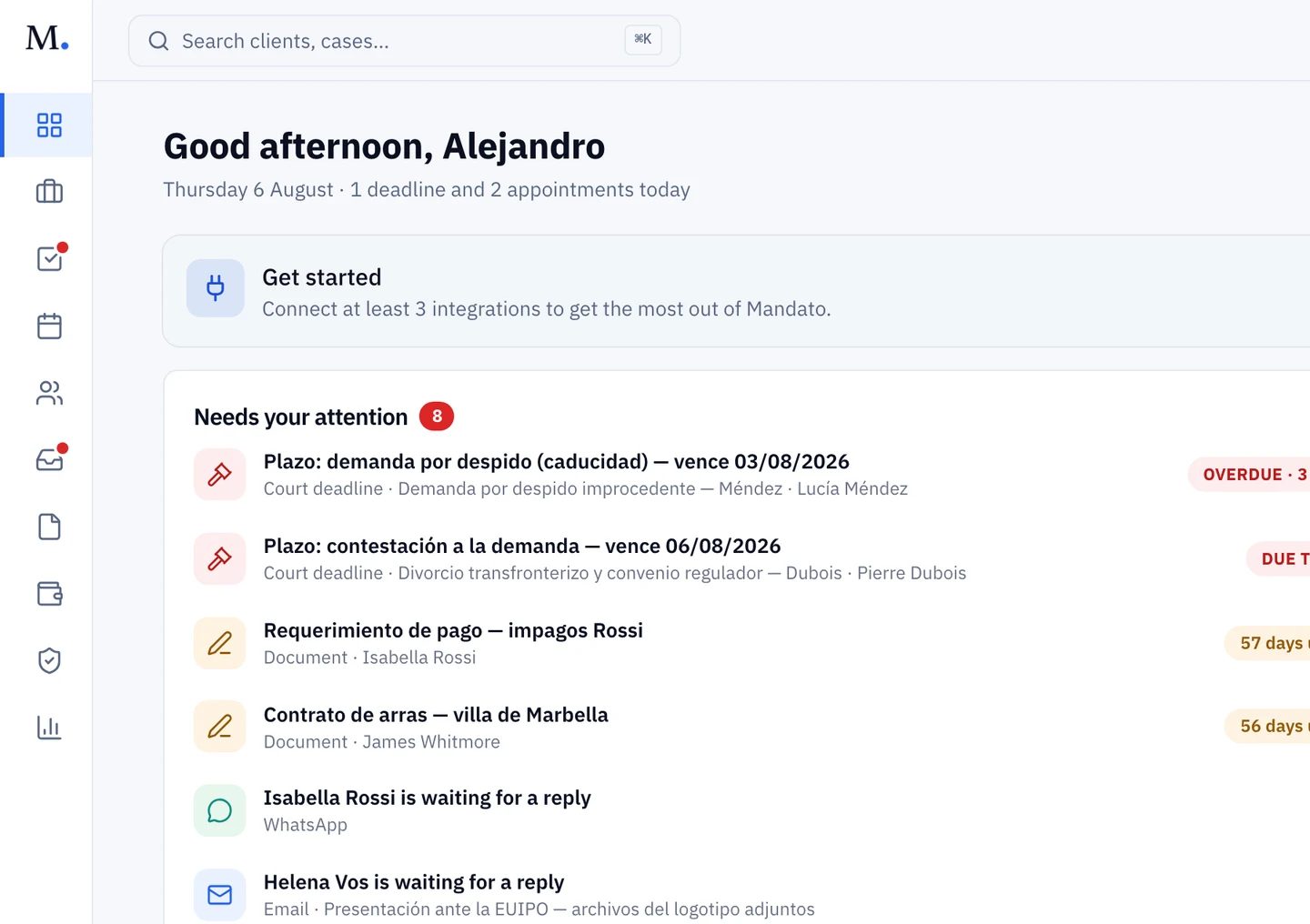
In Mandato, the case record holds the matter’s data, court included, and the LexNET notifications the firm receives are organised inside the case they belong to. The latest designation the court used is in front of whoever is drafting, and the deadlines each notification opens go into the calendar. Filing still happens in LexNET. What the tool adds is that the starting data lives in one place, in plain view. If your practice is mostly civil, the civil litigation page has the detail for that kind of work.
Less admin. More law.
Mandato brings matters, communications, billing and compliance into one platform built for firms in Spain.