Practice management software for Spanish law firms: a 2026 comparison
Sage Despachos, Wolters Kluwer's Kleos, Lefebvre's LexON and Mandato, compared on what actually separates them: which category each one plays in, which price you can verify, and which part of the Spanish administration it talks to. Written by Mandato.
 By Roberto Rubio8 min read
This is published by Mandato, which is one of the four products below. Discount it accordingly. In exchange, here is a rule you can check as you read: each competitor is described first by what it wins at, and where we have no verified public figure, the sentence says so rather than implying a gap.
Start with the uncomfortable part. The four products in this comparison do not really compete with each other; they belong to three different categories of software, and the most expensive buying mistake in the Spanish market is not picking the wrong brand but the wrong category. A firm that needed an accounting and tax engine and bought a matter manager ends up with two tools and an external accountant. A firm that needed to track deadlines and bought a modular suite ends up paying for modules nobody opens.
That is the only opinion in this article. The rest is data.
The three categories
The accounting and tax engine. Its centre of gravity is bookkeeping, tax filings and payroll. The legal matter exists, but it orbits. Sage Despachos lives here.
The legal publisher’s suite. A matter manager built around a database of case law and legislation, with a publishing group’s editorial apparatus behind it. Kleos (Wolters Kluwer) and LexON (Lefebvre) live here, and mostly compete with each other.
The operational manager. Matters, deadlines, documents and client communication, with no legal database of its own and no tax accounting inside. Mandato lives here, alongside Clio, Sudespacho and MN Program.
No category is superior. What changes is which problem it solves unaided, and what you will need a second tool for.
Sage Despachos — the accounting engine, sold through resellers
Sage Despachos Connected automates the accounting, tax and payroll processes of a professional firm. It is modular and scalable, runs in the cloud and on the desktop, and its natural buyer is the asesoría or the mixed practice that keeps its clients’ books as well as their files.
What it does well, and this is not arguable: if your firm files tax returns, closes financial years and runs payroll, Sage handles inside what nearly everything else on this list handles by exporting. That is a real process saving, not a checkbox. And behind it is a global vendor with twenty years of continuity in Spain.
How you buy it. Sage Despachos is not bought on a website with a card. It comes through a reseller — Aelis, Opentix, Advantys, Control Group, Cronomia and several more — who quotes you on users, modules and deployment mode. There is no public per-user monthly price. That cuts both ways: you get someone who implements the system and answers for it, and you cannot compare the cost with anyone without sitting through a sales meeting.
Where it does not play. Sage is not a litigation management product. If what hurts is court deadlines, notifications and following a case, you will need something else beside it.
Kleos (Wolters Kluwer) — the suite with the most miles on it
Kleos has been running in Europe for over thirty years and Wolters Kluwer states more than 30,000 professionals use it. It comes in three plans — Essential, Pro and Business — and Spanish legaltech directories list it from around €39/month, though Wolters Kluwer does not publish a per-user rate on its own site that you can check without asking for a quote.
What it does well: matter management integrated with Outlook, time recording, multi-currency billing, bulk invoicing, iOS and Android apps, and Kleos Connect for sharing documents with third parties. The platform is ISO 27001 certified — the platform, which is worth stating precisely, and which is more than many of us can say — and it offers Azure Active Directory sign-in, which matters a great deal in a twenty-person firm with its own identity policy.
Behind it sits Wolters Kluwer’s document ecosystem, and a network of implementation, training and in-person support that no young company matches overnight. If your firm values the continuity of a global publishing group above everything else, Kleos is a defensible choice and we are not going to pretend otherwise. We go into it in more detail in the head-to-head Mandato vs Kleos.
LexON (Lefebvre) — same shelf, different ecosystem
LexON is Lefebvre’s answer to Kleos, and it competes on the same ground: matters, time, retainers, billing and reporting, all hanging off a legal database.
What it does well: the LexNET integration syncs and keeps the CTEAJE court directory up to date, one of those details only appreciated by someone who has had to correct them by hand. DocsIA — part of GenIA-L, Lefebvre’s generative AI — analyses documents and summarises them. QMemento supplies legislation, case law and templates. And there is a cheaper way in, LexON VeriFactu, built to issue electronic invoices tied to the matter and migrate to the full version later: for a small firm whose only problem is invoicing, that is a sensible place to start.
What it gets criticised for, consistently across independent reviews: an initial learning curve, and a price that is high for a small firm. Lefebvre does not publish a rate either; there is a free trial, but the number comes out of a conversation.
Mandato — and where we lose
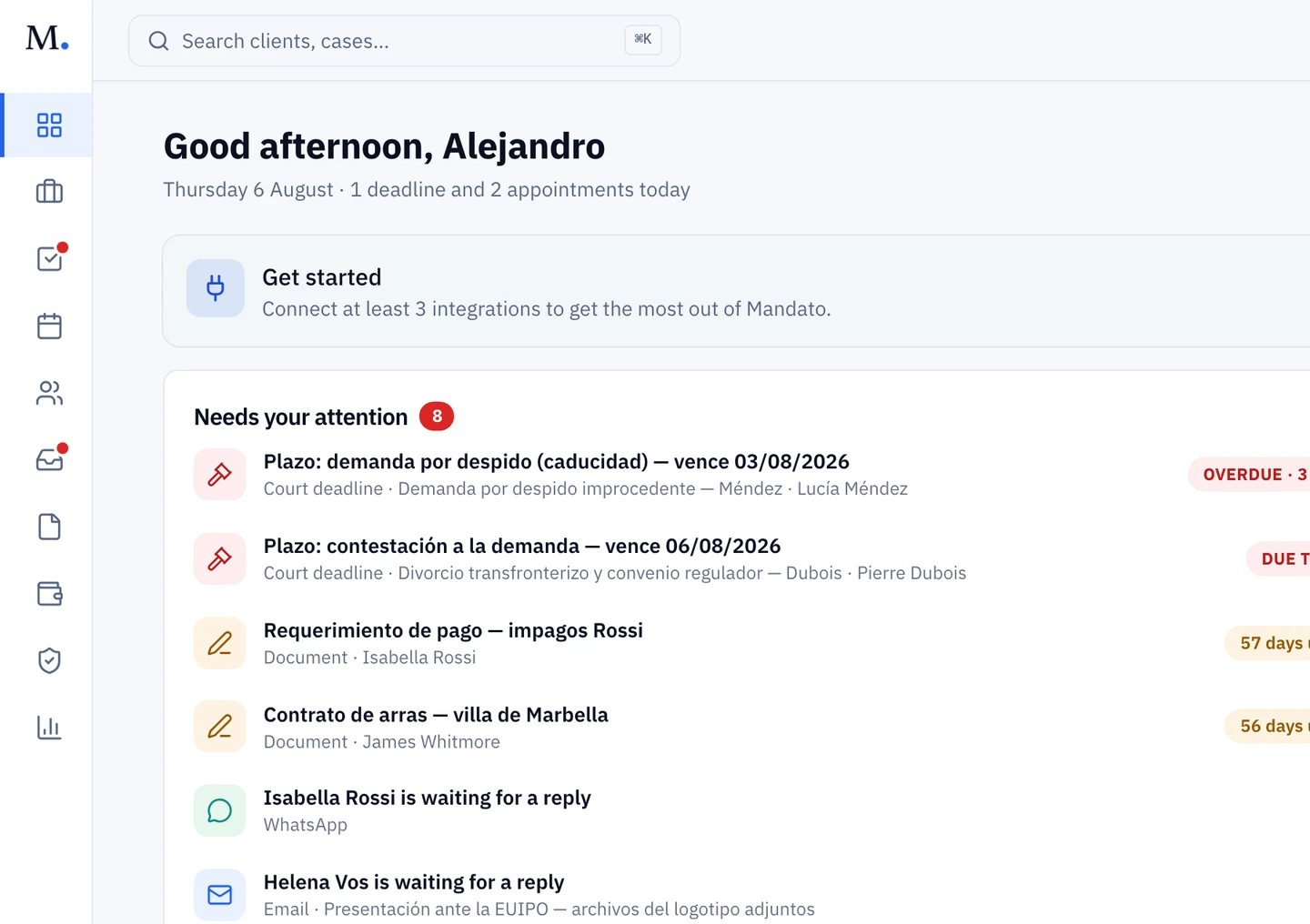
Mandato was built inside a Marbella firm working with international clients, which explains both what it does well and what it lacks.
Where we lose, specifically:
We have no legal database. No case law, no consolidated legislation, no templates library. If research is the centre of your work, Aranzadi Fusión, Kleos or LexON give you something we do not have and are not going to have.
We do not do tax accounting. No official tax forms, no payroll: we export to Holded and the books live outside. Against Sage, that is a difference of process, not of price.
We do not cover Avantius or eJusticia.cat. If you litigate in Aragón, Navarre, Cantabria, La Rioja or Catalonia, that gap outweighs every other line in this comparison. They are on the roadmap, and until they ship, they are out.
For the Land Registry and the Commercial Registry we track the process, not an API that orders the nota simple for you. Once it arrives, the AI reads it and flags charges; getting hold of it is still human work.
And we have no in-person implementation network. If your firm needs someone in the room for three days, that is not us.
Where we win: the price is published and it is the price charged — €49 and €89 per user per month, or €41 and €74 billed annually, plus VAT — with no user or client cap on either plan, which we state here because an undisclosed limit is a trap. LexNET both receives notifications and files documents inside the matter. Billing produces chained VeriFactu records with QR codes as standard, and submission to the AEAT with your own certificate is in homologation. WhatsApp Business stays tied to the matter. And AI sits in every workflow rather than in a separate module.
The three questions that actually decide it
After all this, the comparison comes down to three things. None of them appears in a demo.
Can you verify the price before the meeting? Three of the four products here are sold by quote. That does not make them worse — a quote usually comes with implementation included — but it does mean you cannot compare without handing over your phone number. Know which one you are accepting.
Which part of the administration do you need to talk to? Not the part on the vendor’s website: yours. A litigation practice in Zaragoza and a real-estate boutique in Marbella do not need the same connections, and whichever one is missing will cost you in working hours, not in licence fees.
How do you get out? Ask to see the export during the demo: what format matters, documents, contacts and invoices come out in, and whether you can run it yourself without opening a ticket. The answer tells you more about a vendor than its feature list.
One date is worth adding on VeriFactu, because it changes how urgent the purchase is: Royal Decree-Law 15/2025 set 1 January 2027 for companies and 1 July 2027 for the self-employed and everyone else in scope. 2026 is the voluntary period. There is no rush this week; there is a good reason not to buy something you will have to replace in eighteen months.
So which one
If your firm keeps its clients’ books, start with Sage and then find a matter manager that lives alongside it.
If legal research is the work and you want the library on the same screen, the choice is between Kleos and LexON, and it is settled by which ecosystem — Wolters Kluwer or Lefebvre — you already use daily.
If what hurts is matters, deadlines, documents and talking to clients who write to you in three languages, look at the third category, with Mandato in it and our direct competitors beside it.
We have written a longer guide covering seven products, sorted by who each one is for, and head-to-head comparisons with the ones that resemble us. If you are still torn between two after reading them, the tie-break is usually the exercise almost nobody does: ask each vendor to walk your own four workflows using your own matters, instead of watching the standard demo.
Less admin. More law.
Mandato brings matters, communications, billing and compliance into one platform built for firms in Spain.